Live Model Stage
From uncertain inputs to inspection decisions
The baseline keeps Table 2 inputs as probability distributions. The twin propagates uncertainty into flaw depth and probability of failure instead of collapsing it into one fixed value.
- Probabilistic inputs
- Bayesian network
- Threat mechanisms
- Decision loop
1. Spatial Pipe State
Corrosion mechanisms along the pipeline
Uniform corrosion
The highlighted threat chain is synchronized with the Bayesian network and decision panel.
Uniform corrosion
Localized corrosion
Erosion
MIC
2. Bayesian Network
Evidence updates threat probabilities
P(threat | evidence) ∝ P(evidence | threat) × P(threat)
The Bayesian network passes evidence on water, chemistry, and flow to multiple threat mechanisms, then aggregates them into flaw depth and PoF.
3. Future Risk
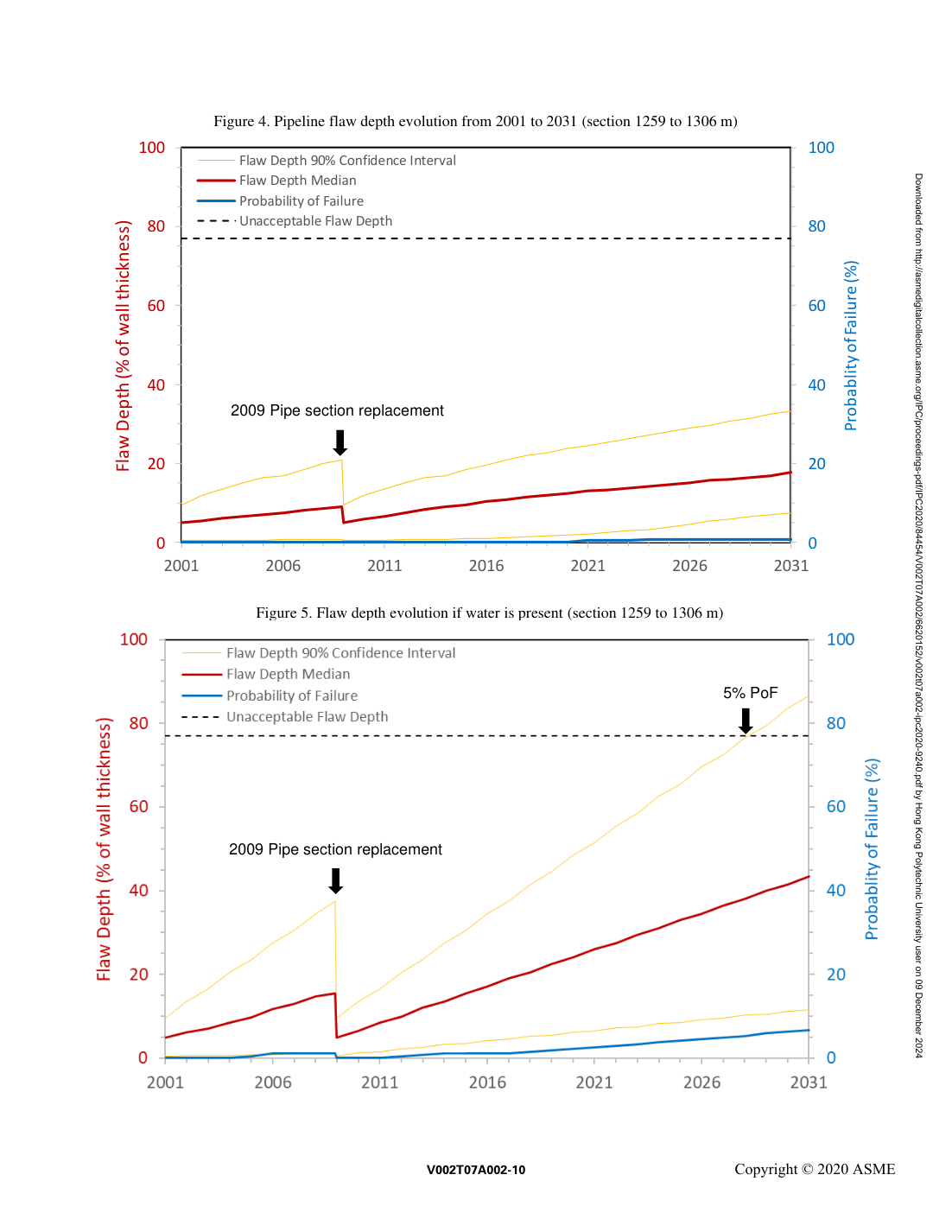
Flaw depth and probability of failure
Teaching simulation calibrated to the paper's baseline and water-present narratives.
4. Decision Maker Panel
When should inspection happen?
Inspection timing
No trigger
PoF below 5%
When PoF reaches the unacceptable-risk threshold you define, the next inspection date appears.
Decision log is empty.
Scenario Inputs
Operate as the decision maker
Learning Story
The four questions this page answers
Conventional digital twins can look precise while hiding missing data, sensor limitations, and model uncertainty.
Inputs enter as distributions, models exchange probabilities, and Bayesian-network nodes update when new evidence arrives.
Set the PoF threshold, test evidence, compare mechanisms, choose inspection timing, choose locations, and prioritize new data.
The core risk is false certainty: late inspection, missed mechanisms, and poor data spending caused by untracked uncertainty.
Paper Evidence
Source-backed anchors
Problem: uncertainty in the information layer can propagate into unsafe conclusions.
Mechanism: Bayesian networks connect prior knowledge, observations, and conditional probability tables.
Decision: unacceptable risk is set as a PoF threshold; inspection timing and data collection follow from the posterior risk.